
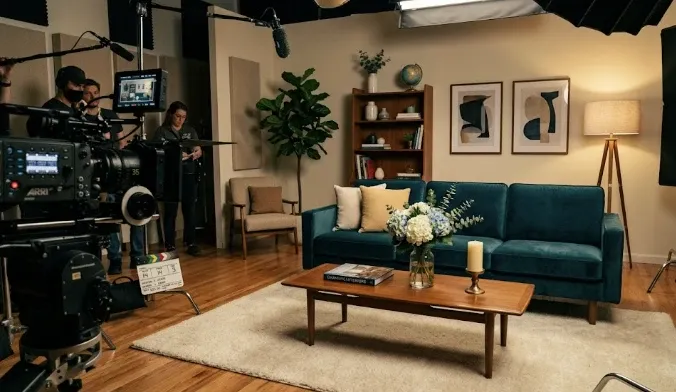
Next time you watch a film or a television drama, pay attention to the furniture. Living room scenes, hotel lobbies, office interiors — the upholstery always looks pristine. Sofas that look like they’ve never been sat on. Armchairs without a mark on them. Rugs that appear freshly laid. No matter how many takes a scene requires, the furniture looks perfect in every single one.
This doesn’t happen by accident. Behind every production is a dedicated team responsible for maintaining the physical condition of set dressing — including every upholstered piece on the floor. The standards they work to, and the methods they use, are worth understanding. Because the same principles that keep a movie sofa looking camera-ready for weeks of shooting apply just as directly to the furniture in your home.
Why Furniture on Film Sets Has to Be Perfect
The demands placed on furniture in a film production environment are genuinely extreme. A single sofa might appear in thirty or forty separate scenes across a shooting schedule that spans several weeks. Dozens of crew members move through the space constantly. Actors sit, stand, lean, and repeat the same movements hundreds of times across multiple takes. Food and drinks are brought onto set. Makeup, wardrobe, and props all create opportunities for accidental contact.
And yet, in every take that makes it into the final cut, the furniture looks untouched. The continuity department and the set dressing team make this happen — and their approach offers several lessons that translate directly to home maintenance.
Lesson 1: Immediate Response to Every Incident
On a working film set, there is no such thing as “I’ll deal with that later.” If something contacts the upholstery — a spilled coffee, a smear of stage makeup, anything — someone is on it within seconds. Not because the damage is necessarily severe, but because the longer any substance sits in a fabric, the more likely it is to set and become significantly harder to remove.
This is one of the most transferable lessons for homeowners, and one of the most frequently ignored. The instinct in most households is to blot a spill, tell yourself it looks okay, and move on. The professional approach — on a film set or in any context where fabric quality matters — is to treat immediately and thoroughly, using the right product for the specific type of stain.
For fabric upholstery, blotting rather than rubbing is always the correct first move. Rubbing spreads the stain and pushes it deeper into the fiber. Blotting lifts it. Then, the correct cleaning agent for the substance — enzymatic cleaner for organic stains, solvent for oil-based marks, plain cold water for many water-soluble spills — is applied before the stain has any opportunity to bond with the fiber permanently.
Lesson 2: Material Knowledge Is Operational Knowledge
Set dressers and prop masters know exactly what every piece of furniture on their floor is made of. This isn’t aesthetic knowledge — it’s operational. They need to know what cleaning products are safe to use, what will cause color bleeding, what will affect texture, and what requires specialist treatment rather than on-set handling.
In home settings, most people have no idea what their sofa fabric is actually composed of. They know it’s “the blue one” or “the velvet-ish one,” but not whether it’s a water-safe polyester blend, a solvent-only fabric, or a natural fiber that requires specific care. The cleaning code on the furniture tag — W, S, WS, or X — tells you everything you need to know about what methods are safe, and most homeowners have never looked at it.
Knowing your material is the foundation of all correct maintenance decisions. It determines what you can apply, what you need to avoid, and when a job requires a professional rather than a home solution.
Lesson 3: Regular Professional Cleaning Is Budgeted In
High-end productions don’t rely solely on immediate spot treatment and daily care. For extended shoots or for pieces that receive particularly heavy use, professional cleaning is brought in during production — not just before and after. It’s treated as a production cost, not a luxury, because the alternative is furniture that gradually degrades in a way that becomes visible on camera.
The residential equivalent is scheduling professional cleaning as a regular maintenance expense rather than an emergency response. Most homeowners call a professional upholstery cleaner when something is visibly wrong. The production mindset is to schedule it on a calendar regardless of visible condition — because visible deterioration means the damage has already been done.
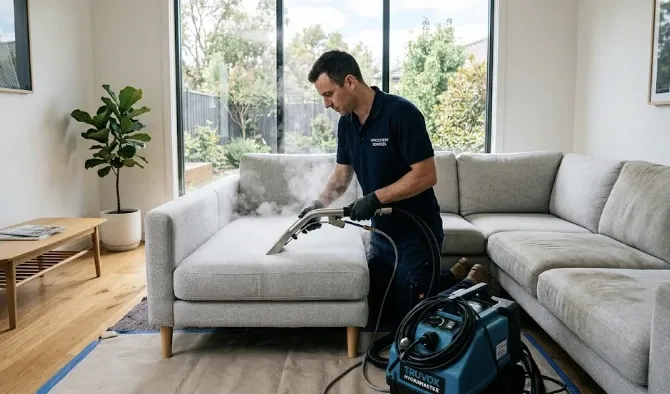
For a standard home sofa in regular use, professional deep cleaning once every 12 to 18 months maintains the fabric at a quality level that extends its lifespan significantly. For households with children, pets, or high traffic, the interval should be shorter. Homeowners in the Seattle metro area looking for upholstery cleaning in Lynnwood WA can typically book same-week appointments with services that bring professional-grade extraction equipment directly to the home — the same caliber of result that production cleaning crews deliver on set.
Lesson 4: The Camera (and Your Guests) See What You’ve Stopped Noticing
There’s a phenomenon well-known to directors of photography: things that are invisible to the eye in person become very apparent on camera. A small stain that you walk past every day without registering it becomes obvious the moment it’s lit and captured on film. The camera doesn’t share your familiarity with the space — it sees it fresh.
Your guests experience your home the same way. You’ve stopped noticing the gradual dulling of the sofa fabric or the flattening of the rug pile, because you see it every day and your brain has adjusted. Someone walking into your home for the first time sees it as it actually is — not as it was when it was new, and not filtered through the familiarity that makes you unconsciously forgiving of its current state.
Production designers know this, which is why they never trust their own familiarity with a set as a quality standard. They check against fresh eyes, against what the lens will capture. Applying the same principle at home means occasionally stepping back and genuinely assessing the condition of your upholstery as a visitor would — and acting on what you see rather than explaining it away.
Lesson 5: Prevention Costs Less Than Restoration
A damaged or heavily soiled piece of upholstery in a production context is a problem — because replacing or restoring it mid-shoot is expensive, disruptive, and sometimes impossible if the piece is a specific prop or a licensed item. Prevention is therefore the entire strategy: protect the fabric, treat problems immediately, and maintain consistently.
The math at home is identical. A sofa that receives regular professional maintenance every year or so will last significantly longer than one that doesn’t. The cost of annual professional cleaning is a fraction of the cost of replacement. Stains that are treated immediately cost nothing to address. Stains that have been sitting for months or years may be permanent — meaning the entire piece is compromised.
Prevention isn’t just cheaper in the long run. It’s also the approach that keeps your home looking the way it did when you first furnished it — rather than the gradual, barely-noticed decline that most upholstery goes through when maintenance is reactive rather than deliberate.
The Takeaway
Film productions make furniture look perfect because they treat its maintenance as a professional discipline, not an afterthought. Material knowledge, immediate response, scheduled professional cleaning, and a prevention-first mindset combine to produce results that are consistently better than what reactive, hope-for-the-best home maintenance produces.
None of these principles are complicated or expensive. They’re mostly a matter of paying attention, knowing what you’re working with, and treating your furniture with the same seriousness that a production team brings to assets that need to look good under the most unforgiving conditions imaginable.