
In modern education, schools are no longer limited to delivering standard academic knowledge. They increasingly function as innovation hubs where students learn to think critically, conduct research, and develop solutions to real-world problems. One of such institutions in Ukraine is the Khmelnytskyi Lyceum “Moyi Obrii”, a learning environment where academic curiosity is transformed into structured research and project-based learning.
Khmelnytskyi Lyceum “Moyi Obrii” is known for encouraging students to engage in interdisciplinary research across natural sciences, linguistics, history, psychology, and information technology. The school fosters an educational model in which learners are not passive recipients of knowledge but active participants in the creation of new ideas, hypotheses, and practical applications.
A learning environment built around research and creativity
The core philosophy of the lyceum is centered on inquiry-based education. Students are guided to formulate research questions, design methodologies, collect and analyze data, and present their findings in structured academic formats. This approach develops not only subject-specific knowledge but also essential 21st-century skills such as analytical thinking, communication, collaboration, and digital literacy.
Research activities at the lyceum often extend beyond the classroom. Students prepare projects for national and international competitions, academic conferences, and scientific exhibitions. These experiences provide them with early exposure to academic standards and help them build confidence in presenting their work to broader audiences.
Fields of study and interdisciplinary projects
The diversity of student projects at Khmelnytskyi Lyceum “Moyi Obrii” reflects the interdisciplinary nature of modern science and humanities. In natural sciences, students may investigate environmental issues, biological processes, or experimental physics concepts. In IT, they work on programming, data analysis, and digital solutions to practical problems.
In linguistics and literature, research often focuses on language evolution, translation studies, and cultural analysis. Historical studies allow students to explore regional and global events through archival research and critical interpretation. Psychology projects frequently examine human behavior, learning processes, and social dynamics.
This wide range of disciplines ensures that students can develop their interests while also understanding how different fields of knowledge interact in real-world contexts.
Challenges in implementing advanced student research
Despite the strong academic culture, meaningful research requires resources that are not always readily available in a school environment. Many student projects depend on access to specialized laboratory equipment, scientific materials, or licensed software for data processing and modeling.
In addition, participation in academic conferences and competitions often involves travel expenses, registration fees, and logistical support. Students may also require consultations with external experts, university lecturers, or industry professionals to refine their research methodologies and validate their findings.
These requirements can create financial barriers that limit the full realization of otherwise highly promising ideas.
Why external support matters
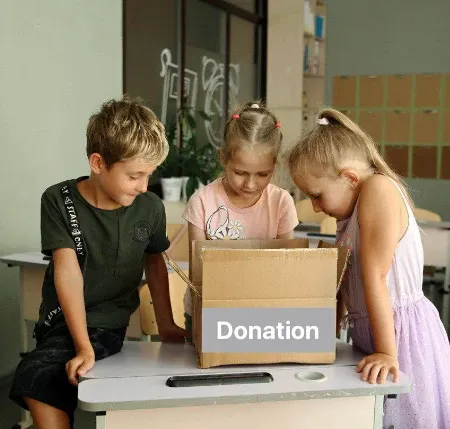
Supporting educational initiatives like those at Khmelnytskyi Lyceum “Moyi Obrii” is not simply an act of charity; it is an investment in long-term intellectual and technological development. Even relatively small contributions can have a direct impact on a student’s ability to complete a project, participate in a competition, or access necessary research tools.
Financial support can be directed toward several key areas:
- Purchasing laboratory and experimental equipment
- Providing access to professional software and digital platforms
- Funding participation in academic conferences and contests
- Organizing workshops with invited experts and researchers
- Supporting collaborative projects between students and mentors
Each of these components plays a role in transforming theoretical ideas into tangible outcomes.
The broader impact of student research
The importance of student research extends beyond individual academic achievement. Many school-level projects serve as early prototypes for larger scientific or technological developments. A well-structured student study can evolve into university-level research or even practical innovations with social or environmental impact.
Moreover, engaging students in research at an early age helps develop a culture of scientific thinking. It encourages young people to approach problems systematically, rely on evidence rather than assumptions, and remain open to continuous learning.
In the long term, such skills contribute to the development of a more knowledgeable and innovative society.
Building a community of support
Educational progress is most effective when it involves collaboration between schools, families, local communities, and broader supporters. Khmelnytskyi Lyceum “Moyi Obrii” represents a model in which this collaboration is essential for sustaining student research initiatives.
By supporting the lyceum, donors and partners contribute to a system that nurtures intellectual potential and prepares students for future academic and professional challenges. This kind of engagement strengthens not only individual learners but also the educational ecosystem as a whole.
More detailed information about how to contribute can be found through the official support page: Support Khmelnytskyi Lyceum “Moyi Obrii”
Conclusion
Khmelnytskyi Lyceum “Moyi Obrii” demonstrates how modern education can move beyond traditional instruction and become a platform for real scientific exploration. Its students are already working on meaningful projects across multiple disciplines, but their potential depends significantly on access to resources and external support.
Investing in such initiatives means investing in future scientists, researchers, engineers, and thinkers who may contribute to solving complex global challenges. Even modest assistance can help transform a student’s idea into a fully realized project with lasting impact.